Why Does the Circular Ring 2 Need a Cuff Calibration for Blood Pressure?
You open the Circular app, tap Blood Pressure, and the first thing it asks for is not a reading. It asks for three numbers from a blood pressure cuff you already own.
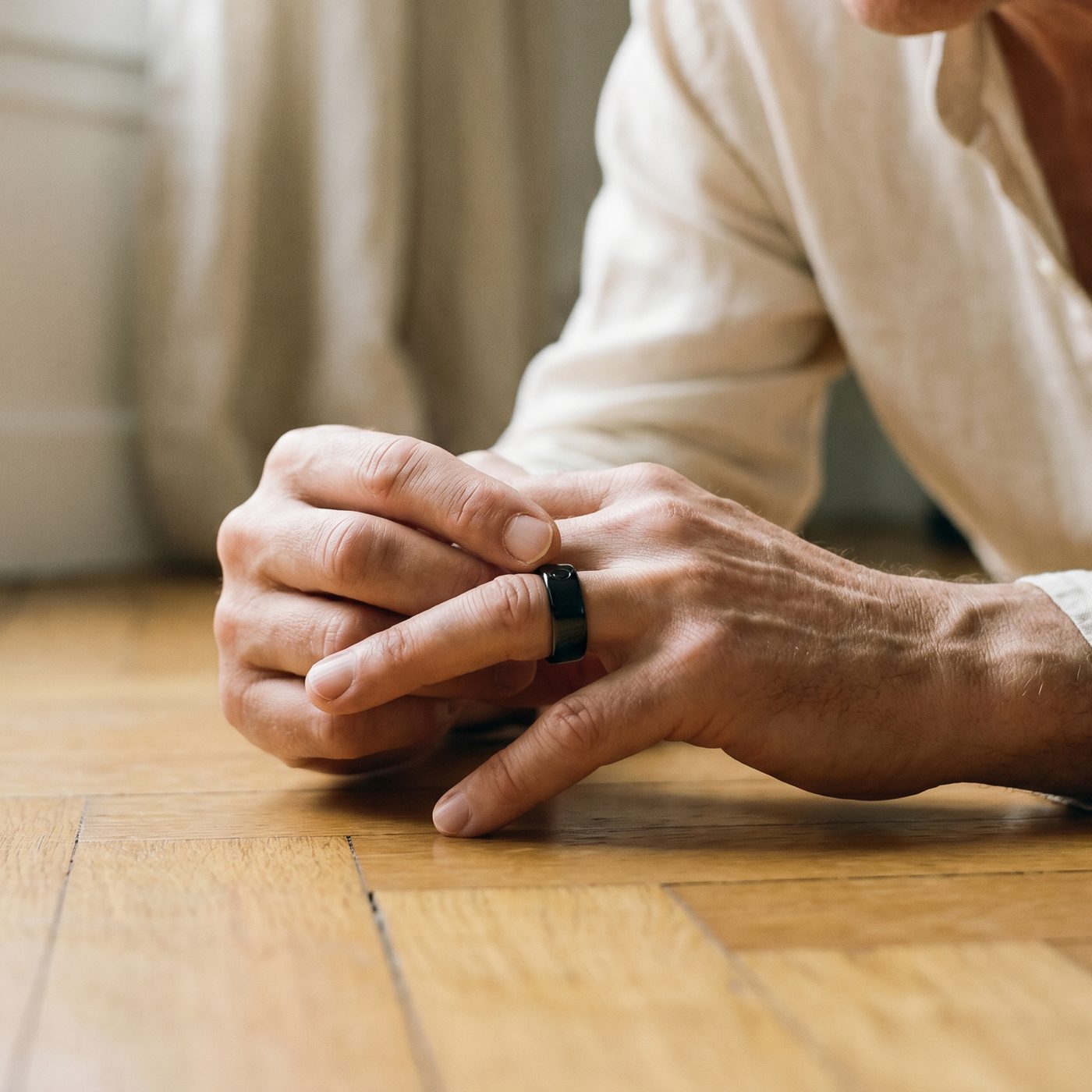
That can feel like a catch. Why does a smart ring, the thing you bought so you could stop juggling extra gadgets, need a separate cuff before it will tell you anything at all?
It’s the whole reason the number is worth trusting. A cuffless sensor measures the speed of your pulse wave, not pressure itself. Calibration is the step that turns the first into the second. This piece explains the physics in plain terms, so you know exactly what the ring is doing and what the number on screen actually means.
How a Cuff Measures Blood Pressure Directly
A traditional cuff is a mechanical instrument, and it works by brute force.
The cuff wraps around your upper arm and inflates until it squeezes your brachial artery completely shut. Then it releases the pressure slowly and listens for the moment blood starts and stops moving again. The pressure at which flow returns is your systolic number, the top one. The pressure at which the artery is fully open and quiet is your diastolic, the bottom one.
This is a direct measurement. The cuff physically compresses the artery and reads the pressure required to do it. That’s why an arm cuff remains the reference standard every other method is judged against. The European Society of Hypertension, in its 2023 guidelines, still points to validated cuff monitors as the benchmark for both diagnosis and home monitoring.
The problem with the cuff is not its accuracy. It’s everything else. You can’t wear one all day. You can’t sleep in one. Most people check their pressure once or twice a year, in a clinic, in a chair they arrived at in a hurry, and that single reading then has to represent a number that moves constantly.
How a Ring Estimates Pressure Without a Cuff
A ring cannot occlude an artery. There is no physical way to compress the brachial artery from a finger, so the Circular Ring 2 measures something else entirely and infers pressure from it.
That something else is the speed of your pulse wave. Every single heartbeat produces two events that can be timed separately.
The first is electrical. When your heart contracts, it fires an electrical impulse that shows up on an electrocardiogram (ECG) as the sharp R peak. Think of it as the starting gun.
The second is mechanical. The pressure wave created by that contraction travels down your arteries and reaches your finger a few hundred milliseconds later, where it slightly changes how much light your tissue absorbs. That change is captured by photoplethysmography (PPG), the same green and red light sensing used to track heart rate.
The interval between the electrical event and the mechanical arrival is called pulse wave transit time, or PWTT. Stiffer, more pressurised arteries carry that wave faster. Lower pressure, slower wave. The inverse relationship between transit time and systolic pressure is well established in the physiological literature, and it’s the basis of essentially all cuffless blood pressure research. A review published in IRBM in 2014 and a widely cited paper in IEEE Transactions on Biomedical Engineering in 2015 both walk through the theory in detail.
The reason very few consumer devices attempt this is that you need both signals, from the same device, on the same heartbeat. PPG alone gives you a waveform with no electrical reference point to time it from. The Circular Ring 2 records ECG and PPG simultaneously, which is what makes transit time computable on a finger at all. That’s also why, during a measurement, you rest a finger from the opposite hand on top of the ring. It completes the electrical circuit the ECG needs.
Here is the difference at a glance.
Why Pulse Wave Speed Is Not the Same as Blood Pressure
Here is the part most cuffless products are vague about, so we’ll be direct.
Pulse wave transit time tells you how fast your pulse wave is travelling. It doesn’t tell you millimetres of mercury (mmHg). The conversion between the two depends on your individual arterial stiffness, the geometry of your vessels, and the anatomy of your finger, and none of those are knowable from the signal alone.
In other words, the ring can measure your pulse speed very accurately while still having no idea what your pressure is in absolute terms. Two people can have the identical transit time and different blood pressures, because their arteries are built differently. Even the same person can see that relationship shift over months.
That’s why transit time is described as a relative signal. It tracks changes over time beautifully. It just doesn’t have an absolute zero. A JAMA piece on cuffless monitoring made the same point back in 2019: the technology is promising precisely because it’s continuous, but it’s not a drop-in replacement for the cuff.
What the Cuff Calibration Actually Does
Calibration supplies the missing anchor.
When you set up blood pressure on the Circular Ring 2, you take three readings with a standard cuff monitor and enter them. Those three points establish your personal relationship between transit time and mmHg. From then on, the ring measures pulse speed and converts it through your own curve, not a population average.
Think of it as setting the time on a watch. The movement is precise from the moment it leaves the factory. It still needs to be told what time it is. Calibration is that one-time act of telling the ring what your pressure actually is, in numbers the cuff has verified, so every future estimate has a real reference to hang from.
Any cuffless device that promises zero calibration is doing one of two things. Either it’s silently applying a population average to you, which is why its readings drift for most individuals, or it’s not really solving the problem. We’d rather ask for two minutes of setup than show you a number with no anchor behind it.
Why You Re-Anchor the Reading Every 30 Days
Your arteries aren’t a fixed instrument. They change.
Arterial stiffness drifts with age, weight changes, medication, and even the season. The relationship between transit time and pressure that held last month won’t hold exactly this month. If you never re-anchored, the estimate would slowly slide away from your true pressure without you noticing, and a number that drifts silently is worse than a number that asks for a quick check.
So the app prompts you for one cuff reading roughly every 30 days. A single reading re-anchors the model. The precise transit-time mechanism hasn’t changed. It just needs to be told, again, where your absolute baseline currently sits. The requirement is published and consistent with how the IEEE standard for cuffless devices treats periodic calibration as a normal part of the method, not a workaround.
What Calibration Does and Does Not Guarantee
Let’s be clear about what you’re getting.
Calibration makes the estimate anchored to your own body, which is the difference between a trend you can act on and a generic number. But it doesn’t turn the ring into a medical device. The Circular Ring 2 is a wellness device. The blood pressure values in the app are estimates for trend awareness, not for diagnosis, treatment, or any decision about medication.
The honest accuracy picture looks like this. In the lab, cuffless methods built on pulse transit time have been shown to track systolic changes well under resting conditions, with a wearable study published in the IEEE Journal of Biomedical and Health Informatics in 2021 reporting readings within a few mmHg of a cuff for a seated, still participant. Movement, talking, or a loose-fitting ring degrades the signal, which is why the app asks you to sit still for the measurement. Macro trends across days and weeks are where a ring genuinely helps. A single spot reading during a stressful moment is not.
What the calibration does, then, is give you confidence in the direction and scale of your trends. What it doesn’t do is replace a validated cuff for a medical decision. If your readings sit consistently in the elevated or hypertensive bands, the right next step is a doctor and a cuff, not a change you make on your own.
How to Calibrate the Ring Correctly
The accuracy of the whole system rests on how well the initial cuff readings are taken, so the app walks you through it instead of assuming you know.
Following European Society of Hypertension guidance, the calibration flow asks you to confirm you have avoided caffeine, exercise, alcohol, food, and smoking in the previous 30 minutes, and to sit quietly for five minutes beforehand. It then covers posture: back straight and supported, both feet flat on the floor, and your arm resting on a flat surface at heart level.
None of this is ceremony. A brisk walk up the stairs before a reading moves your systolic pressure by more than the gap between two adjacent classification bands. If the anchor readings are taken sloppily, every future estimate inherits that error. Take the three cuff readings seriously and the rest follows.
For the mechanics of how the ring computes a reading in the first place, we have a companion post that walks through the full measurement. It covers the 20 high quality beats, the roughly 60 second session, and what you see on screen afterwards. You can read it here: How the Circular Ring 2 Measures Blood Pressure Without a Cuff.
Frequently Asked Questions
Q: Do I need a cuff every time I take a reading?
A: No. You only need a cuff during the one-time setup, where you enter three readings, and then one reading roughly every 30 days to re-anchor the model. Daily measurements are cuff-free.
Q: Why can’t the ring just tell me my pressure without calibration?
A: Because the ring measures pulse wave speed, which is a relative signal. It has no absolute zero, so without a personal anchor from a cuff it can’t convert speed into millimetres of mercury for your specific arteries.
Q: Is the blood pressure reading accurate?
A: Under resting conditions, with a correctly taken calibration, cuffless methods based on pulse transit time track systolic trends well. But it’s an estimate for wellness tracking, not a medical measurement. Validate anything concerning with a cuff.
Q: How often do I need to recalibrate?
A: Roughly every 30 days. Your arterial properties drift with age, weight, medication, and season, so the app prompts you for a single cuff reading to re-anchor the baseline.
Q: Is the Circular Ring 2 a medical device?
A: No. It’s a wellness device. The blood pressure feature is for trend awareness. The ECG feature is powered by an FDA-cleared algorithm, but the hardware itself is not FDA-cleared, and nothing in the app is a substitute for a doctor.
Q: What conditions give the best reading?
A: Sit still for five minutes, avoid caffeine, food, alcohol, exercise, and smoking for 30 minutes beforehand, keep your back supported and feet flat, and rest your arm at heart level. Movement degrades the signal.
Take the Quiz: See Where You Stand
The Circular Ring 2 is the only smart ring with ECG electrodes and cuffless blood pressure. No subscription on core features. Explore the Circular Shop. Learn more
References
- Mukkamala R, Hahn JO, Inan OT, et al. Toward Ubiquitous Blood Pressure Monitoring via Pulse Transit Time: Theory and Practice. IEEE Transactions on Biomedical Engineering. 2015. https://doi.org/10.1109/TBME.2015.2441951
- Ganti VG, Carek AM, Nevius BN, et al. Wearable Cuff-Less Blood Pressure Estimation at Home via Pulse Transit Time. IEEE Journal of Biomedical and Health Informatics. 2021. https://doi.org/10.1109/JBHI.2020.3021532
- Allen J. Photoplethysmography and its application in clinical physiological measurement. Physiological Measurement. 2007. https://doi.org/10.1088/0967-3334/28/3/R01
- Stergiou GS, et al. 2023 ESH Guidelines for the management of arterial hypertension. Journal of Hypertension. 2023. https://doi.org/10.1097/HJH.0000000000003480
- Peter L, Noury N, Cerny M. A review of methods for non-invasive and continuous blood pressure monitoring: Pulse transit time method is promising? IRBM. 2014. https://doi.org/10.1016/j.irbm.2014.07.002
- Abbasi J. Cuffless Blood Pressure Monitoring. JAMA. 2019. https://doi.org/10.1001/jama.2019.15537
- Circular. How the Circular Ring 2 Measures Blood Pressure Without a Cuff. https://www.circular.xyz/post/blood-pressure-circular-ring-2