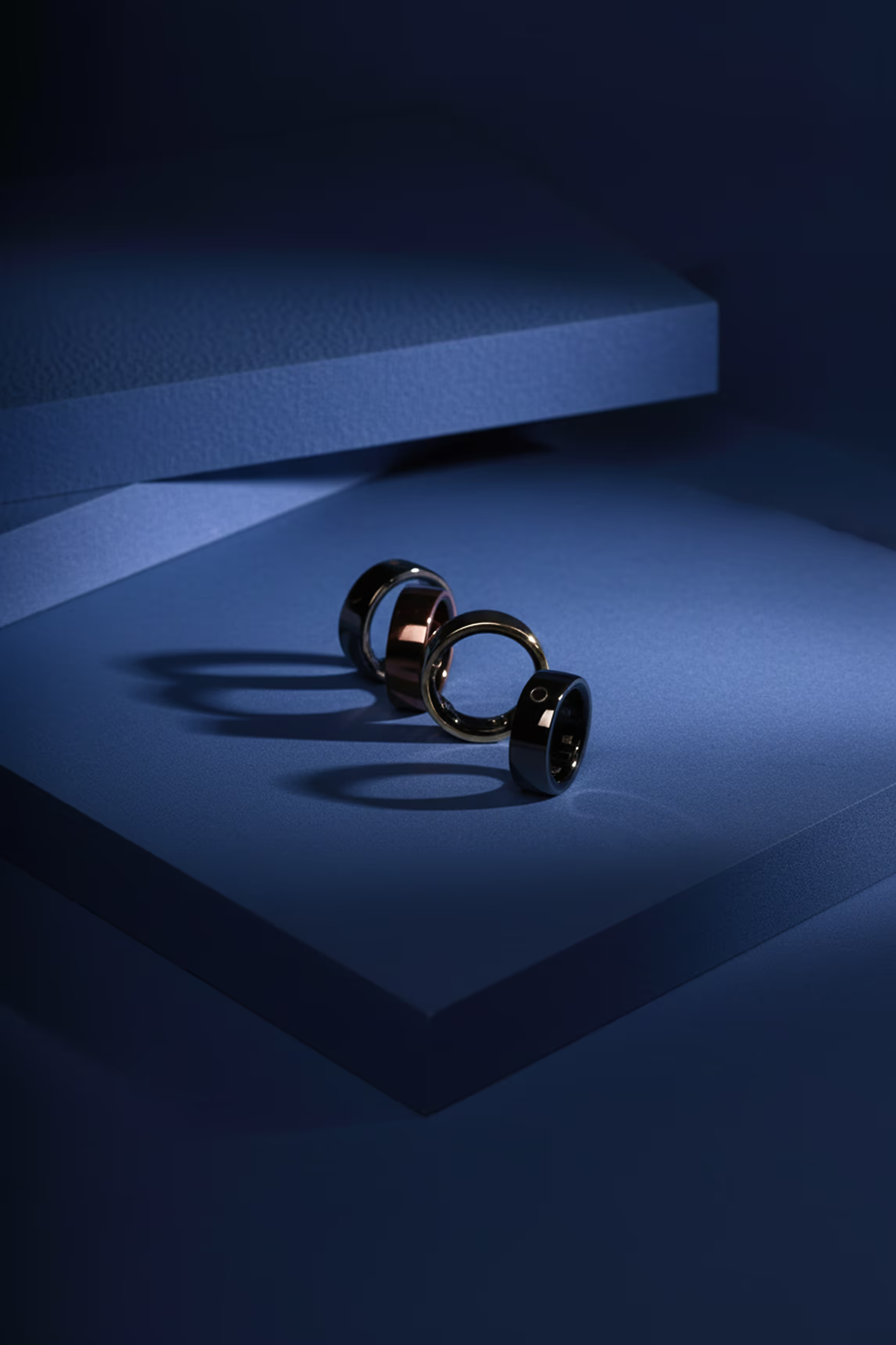
Can a Smart Ring Track Blood Pressure?
Here is the short answer, before the details: yes, a smart ring can estimate your blood pressure, but it works differently from the cuff you know. A smart ring needs a one-time calibration to be meaningful, and the result must be taken as a wellness trend, not a medical reading.
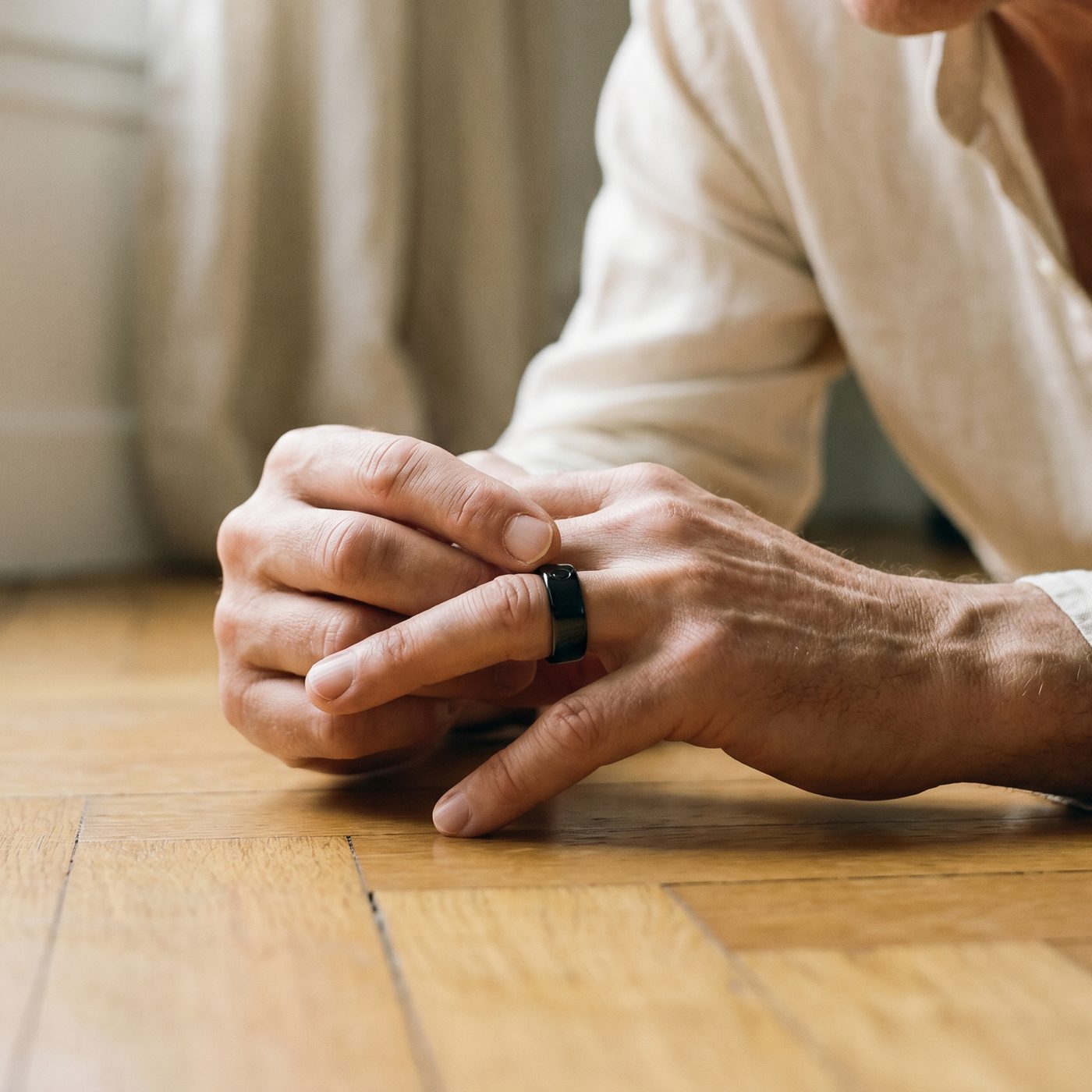
The longer answer is worth understanding, because blood pressure is one of the most important health numbers most people measure the least often. A single reading at a yearly checkup tells you almost nothing about what your pressure does across a normal week. A ring you wear every day could tell you a lot more, if it works.
So the real question is not “can it” but “how, and how much should I trust it.” This guide walks through both.
What Blood Pressure Actually Is
Blood pressure is the force your blood exerts on the walls of your arteries as your heart pumps. It’s recorded as two numbers, measured in millimetres of mercury (mmHg). EG. 120/80 mmHg
The top number, systolic pressure, is the force when your heart contracts and pushes blood out. The bottom number, diastolic pressure, is the force when your heart relaxes between beats. A reading of 120/80 mmHg means 120 systolic and 80 diastolic.
Why it matters: sustained high blood pressure, or hypertension, quietly damages blood vessels, kidneys, and the brain over years, usually with no symptoms. That’s why it’s called the silent condition. The 2023 guidelines from the European Society of Hypertension define the categories most modern devices use, from optimal (below 120/80) through normal and elevated, up to three stages of hypertension.
How a Cuff Measures Blood Pressure
A traditional cuff measures pressure directly. It inflates around your upper arm until it squeezes the brachial artery shut, then releases slowly while listening for when blood starts and stops flowing again. The pressure at which flow returns is systolic. The pressure at which the artery is fully open is diastolic.
Because it physically compresses the artery, the cuff is the gold standard. Everything else, including any smart ring or watch, is ultimately judged against a validated cuff.
The cuff’s weakness is not accuracy; you know how to use them. It’s everything else. You can’t wear it all day, and most people use one only when they already feel unwell or when a doctor asks. That sparse sampling is the exact gap a ring is built to fill.
Not All Cuffs Are Equal
Cuffs come in three form factors, and they are not interchangeable.
Upper arm is the reference. The 2023 European Society of Hypertension guidelines recommend automatic electronic upper-arm cuff devices for both office and home use. The cuff sits over the brachial artery, a large vessel close to the heart, which is what makes the measurement reliable.
Wrist is acceptable, but second-best. Two things work against it. The radial artery at the wrist is smaller and further from the heart, and the pressure wave amplifies as it travels outward, which distorts the systolic number. More importantly, the wrist has to be held exactly at heart level. Every 10 cm the cuff sits below your heart adds roughly 8 mmHg of hydrostatic pressure to the reading. On an arm cuff, the cuff is already at heart level when you sit normally. On a wrist, you have to hold the position yourself, and most people don’t. STRIDE BP, the validated-device registry the ESH points to, lists wrist devices for home use but reserves its "preferred" status for upper-arm devices only.
There is also the manual version, a cuff plus a stethoscope, which remains the reference method in research. It needs training to do properly, mercury devices are being phased out, and it is not a home tool.
The Two Things That Matter More Than Shape
Validation. Most blood pressure monitors sold have never been clinically validated. STRIDE BP lists around 390 validated devices out of more than 4,000 on the market. A monitor is validated when it has been tested against a reference under a formal protocol, currently ISO 81060-2:2018, which requires the device to agree with the reference within a mean difference of 5 mmHg and a standard deviation of 8 mmHg. Before you buy any cuff, look it up on stridebp.org. The shape matters less than whether anyone checked that it works.
Cuff size. This is the most underestimated source of error in home blood pressure, and the numbers are not subtle. In the Cuff(SZ) randomized crossover trial, 195 adults were measured with a standard "regular" cuff and with the cuff their arm circumference actually called for. Using a regular cuff on someone who needed an extra-large cuff overstated systolic pressure by 19.5 mmHg on average (95% CI 16.1 to 22.9). Someone who needed a large cuff read 4.8 mmHg high. Someone who needed a small cuff read 3.6 mmHg low. A 19.5 mmHg error is the difference between "normal" and "stage 2 hypertension" on a number you did not misread. So measure your upper arm circumference and buy the cuff that matches it.
Why Measuring Often Matters More Than Measuring Once
Blood pressure is not a fixed number. It moves all day long.
It rises when you climb stairs, drops when you sleep, spikes with stress, and settles after a meal. A single reading taken in a clinic, often after a rushed commute, captures one moment in a signal that never stops moving. Doctors even have a name for the clinic-only spike: white coat hypertension, where pressure reads high simply because you are sitting in a medical office.
That is the argument for a wearable. A ring that samples pressure through the day, over weeks, shows you the trend rather than the snapshot. A slow upward drift over three months is visible in a ring’s history long before it would ever show up as a single alarming reading. That early signal is exactly what the cuff cannot give you, because nobody wears a cuff for three months.
Two Readings, Two Numbers, Same Arm
Take a validated upper-arm cuff, sit still, and measure yourself twice a minute apart. The numbers will differ, often by 5 to 10 mmHg. The device is not broken. Here is what is actually happening.
Your breathing moves it. Every inhalation drops the pressure inside your chest, which changes how much blood returns to the heart and how much it ejects on the next beat. Blood pressure rises and falls with the respiratory cycle, continuously.
Your vessels have a rhythm of their own. Sympathetic nerve traffic to your arteries produces slow pressure oscillations of several mmHg, cycling roughly every ten seconds. These are called Mayer waves. Two cuff readings taken a minute apart catch different points of that wave.
And the device has a tolerance. Even a fully validated monitor is only certified to agree with the reference within a mean difference of 5 mmHg, with a standard deviation of 8 mmHg (ISO 81060-2:2018). "Validated" does not mean "exact." It means "wrong by a known, bounded amount."
Add posture on top of that. The American Heart Association’s measurement guidance attributes several mmHg each to an unsupported back, crossed legs, an unsupported arm, a full bladder, and talking during the reading. Talking alone can add around 10 mmHg.
This is why no guideline asks you to act on one number. Both the ESH and the AHA ask for several minutes of quiet seated rest, then multiple readings a minute or two apart, averaged. The single measurement is not the unit of information. The average is, and the trend across many averages is better still.
Which is the whole argument for wearing something. A cuff gives you three good readings on the days you remember to take them. A device on your finger gives you hundreds of samples across a month. Neither number is perfect. The one with more samples is harder to be misled by.
Can a Smart Ring Actually Measure Blood Pressure?
Yes, but not the way a cuff does.
A ring cannot squeeze your artery. You can’t compress the brachial artery from a finger. So instead of measuring pressure directly, a smart ring measures something else, the speed of your pulse wave, and converts it into a pressure estimate using a calibration you do once with a cuff.
This isn’t unique to one brand. It’s the core method behind essentially all cuffless blood pressure research, described in detail in a widely cited 2015 paper in IEEE Transactions on Biomedical Engineering. What’s rare is a ring that can do it at all, because the method needs two signals at once.
Here is the difference at a glance.
How Circular Ring 2 Estimates Blood Pressure
Every heartbeat creates two measurable events.
The first is electrical. Your heart fires an electrical impulse that appears on an electrocardiogram (ECG) as the R peak. The second is mechanical. The pressure wave from that contraction travels down your arteries and reaches your finger a fraction of a second later, changing how much light your tissue absorbs, which photoplethysmography (PPG) detects.
The time between the two is pulse wave transit time, or PWTT. Stiffer arteries carry the wave faster, which correlates with higher pressure. By measuring PWTT across many heartbeats, a device can estimate pressure, provided it has been anchored to your own body first.
Most smart rings only have PPG, which is why they can’t do this. The Circular Ring 2 has both ECG and PPG sensors, recording them simultaneously, which is what makes the calculation possible on a finger in the first place. That’s also why you rest a finger from the other hand on the ring during a measurement: it completes the ECG circuit.
Worth stating plainly: STRIDE BP does not list cuffless devices at all, and holds that they should not be used for diagnostic or treatment decisions. That is the correct position today, and it is the same one we take. What follows is about trend awareness, not diagnosis.
Why Calibration Is Not Optional
Here’s the part that trips people up. Transit time is a relative signal. It tells you how fast your pulse wave is moving, not what your pressure is in millimetres of mercury.
The conversion depends on your individual arterial stiffness and vessel anatomy, which no sensor can read. So the ring needs a reference. You take three readings with a cuff at setup, and those anchor the ring’s relative signal to your real numbers. After that, you re-anchor with a single cuff reading about every 30 days, because your arteries drift over time.
A ring that promises pressure with zero calibration is applying a population average to you, which is why such readings tend to be unreliable for individuals.
How Accurate Is a Smart Ring for Blood Pressure?
Under the right conditions, the estimate can be surprisingly close to a cuff.
A 2021 study in the IEEE Journal of Biomedical and Health Informatics tested a wearable cuffless device at home and found systolic readings within a few mmHg of a cuff while participants sat still. The key phrase is “sat still.” Movement, talking, and a loose fit degrade the signal fast, because they add noise to the pulse wave timing.
So the accuracy picture is conditional. Resting, calibrated, seated readings track well enough to show you trends over days and weeks. A quick check mid-walk is not meaningful. For this reason, treat the ring as a trend monitor, not a spot-check device, and validate anything concerning with a cuff. This is also why cuffless devices carry their own formal standard, IEEE 1708, which sets out how a cuffless device should be validated before its accuracy claims are taken seriously.
What a Smart Ring Can and Cannot Do for Blood Pressure
What it can do: measure you far more often than a cuff ever will, catch gradual upward drift early, and show you whether your pressure is stable, rising, or falling across a month.
What it cannot do: replace a medical diagnosis. The Circular Ring 2 is a wellness device, not a medical device. The numbers are estimates for trend awareness. If your readings sit consistently in the elevated or hypertensive bands, the correct next step is a doctor and a validated cuff, not a decision you make alone.
The ECG side is a useful complement here. The ECG feature is powered by an FDA-cleared algorithm, though the hardware itself is not FDA-cleared. It detects heart rhythm, which matters because blood pressure and heart health are closely linked, but it’s detection, not diagnosis.
Why the Circular Ring 2 Is Different
Most smart rings measure heart rate and sleep with PPG alone. The Circular Ring 2 adds ECG electrodes, which no other smart ring has, and that changes what’s possible.
Because it records ECG and PPG on the same heartbeat, it can compute pulse wave transit time, which is the basis of cuffless blood pressure. It also brings on-demand ECG spot checks, AFib screening, and continuous heart rate, all in a ring that weighs 2 to 3 grams and lasts up to 8 days on a charge in Power mode.
The blood pressure feature lives in the Circular app, with unlimited measurements included in the core features, no subscription required. Some premium features do use a freemium model, but the core health features are free.
If you want the full engineering behind the measurement, we have a dedicated post on how the ring measures blood pressure without a cuff: How the Circular Ring 2 Measures Blood Pressure Without a Cuff.
Frequently Asked Questions
Q: Can a smart ring really measure blood pressure?
A: Yes, but it estimates pressure from pulse wave speed rather than measuring it directly like a cuff. It needs a one-time cuff calibration to anchor the estimate to your body, and it’s meant for trend tracking, not medical diagnosis.
Q: Is smart ring blood pressure accurate?
A: Under resting, calibrated conditions, it can track within a few mmHg of a cuff. Movement and talking degrade the signal, so accuracy drops outside those conditions.
Q: Do I need a cuff with a smart ring?
A: For calibration, yes. You enter three cuff readings at setup and one roughly every 30 days to keep the estimate anchored. Day-to-day measurements are cuff-free.
Q: Can I replace my blood pressure cuff with a ring?
A: No. A ring is for frequent trend monitoring. Any medical decision or concern should be validated with a cuff monitor and a doctor.
Q: Which smart rings measure blood pressure?
A: Very few, because the method needs simultaneous ECG and PPG. The Circular Ring 2 is the only smart ring with ECG electrodes, which is what makes cuffless blood pressure possible on a ring.
Q: Is the Circular Ring 2 a medical device?
A: No. It’s a wellness device. Its ECG feature uses an FDA-cleared algorithm, but the hardware is not FDA-cleared, and its readings are not a substitute for medical care.
Take the Quiz: See Where You Stand
The Circular Ring 2 is the only smart ring with ECG electrodes and cuffless blood pressure. No subscription on core features. Explore the Circular Shop. Learn more
References
- Mukkamala R, Hahn JO, Inan OT, et al. Toward Ubiquitous Blood Pressure Monitoring via Pulse Transit Time: Theory and Practice. IEEE Transactions on Biomedical Engineering. 2015. https://doi.org/10.1109/TBME.2015.2441951
- Ganti VG, Carek AM, Nevius BN, et al. Wearable Cuff-Less Blood Pressure Estimation at Home via Pulse Transit Time. IEEE Journal of Biomedical and Health Informatics. 2021. https://doi.org/10.1109/JBHI.2020.3021532
- Allen J. Photoplethysmography and its application in clinical physiological measurement. Physiological Measurement. 2007. https://doi.org/10.1088/0967-3334/28/3/R01
- Stergiou GS, et al. 2023 ESH Guidelines for the management of arterial hypertension. Journal of Hypertension. 2023. https://doi.org/10.1097/HJH.0000000000003480
- Abbasi J. Cuffless Blood Pressure Monitoring. JAMA. 2019. https://doi.org/10.1001/jama.2019.15537
- Circular. How the Circular Ring 2 Measures Blood Pressure Without a Cuff. https://www.circular.xyz/post/blood-pressure-circular-ring-2
- * Ishigami J, et al. Effects of Cuff Size on the Accuracy of Blood Pressure Readings: The Cuff(SZ) Randomized Crossover Trial. JAMA Internal Medicine. 2023.
- * STRIDE BP. Principles for device listing (preferred status for upper-arm cuffs, exclusion of cuffless devices). https://stridebp.org
- * ISO 81060-2:2018 criteria, as applied in Journal of Human Hypertension. 2022.