Alcohol and Sleep: What a Drink Does to Your HRV and Heart Rate
A glass of wine helps you fall asleep. It just doesn't help you rest. Here's what alcohol does to your heart rate and HRV overnight, and how to read your own numbers the morning after.
You’ve probably felt it. Two glasses of wine at dinner and you’re out the second your head hits the pillow. Then you’re wide awake at 4 a.m., a bit too warm, your heart thumping harder than it should.
The next morning your sleep tracker backs it up. Heart rate higher than usual. HRV lower. A recovery score that looks like you barely slept.
That gap between how alcohol feels and what it actually does is one of the clearest things a sleep tracker can show you. So here’s the real story on alcohol and sleep: what’s going on in your body, what the research says, and how to use your own numbers to find what works for you.
What alcohol does to your body at night
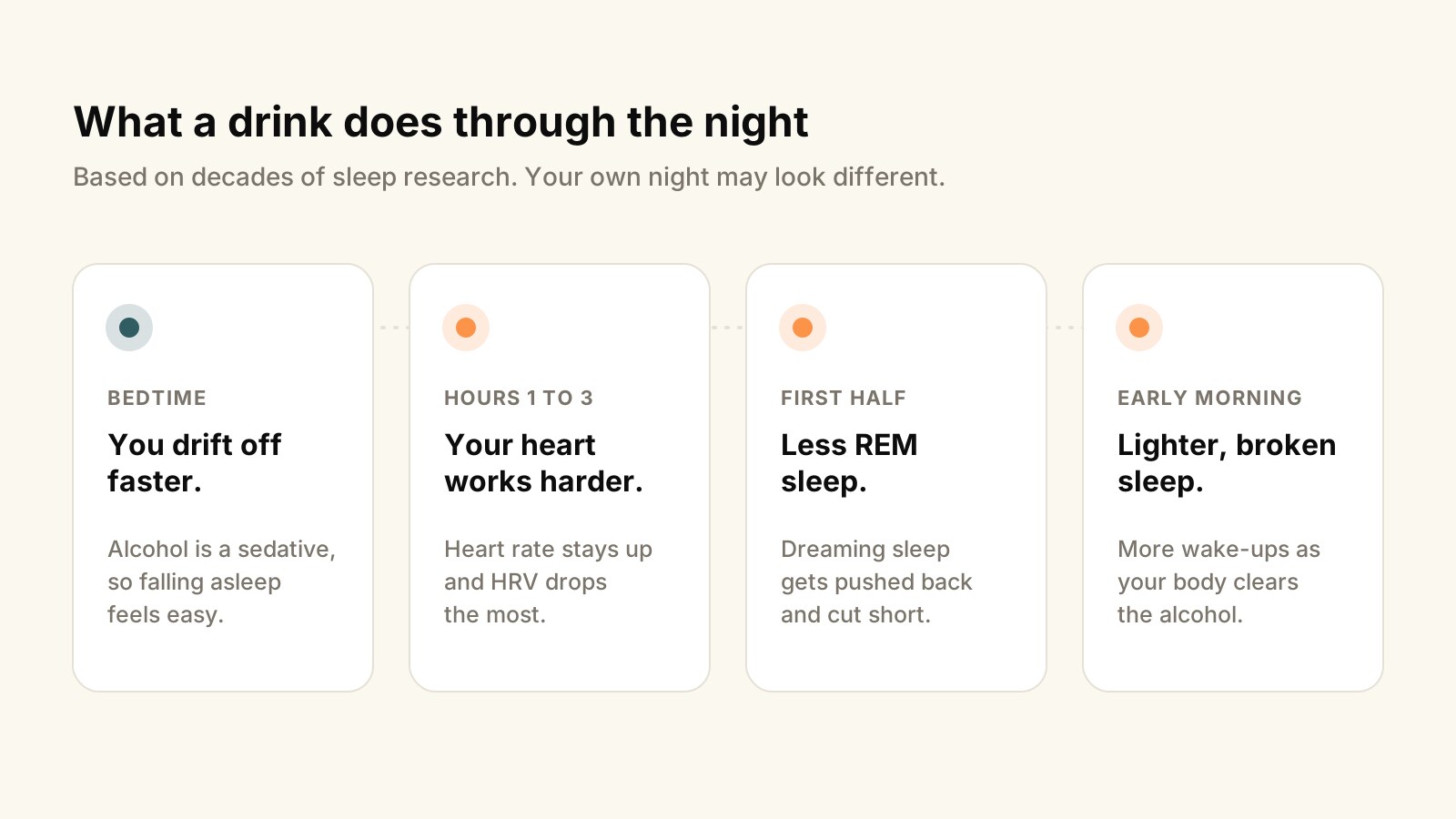
Alcohol is a sedative. In the first hour or two it slows your brain down, which is why you nod off faster.
But your body still has to deal with it, and it does that work while you sleep. As your liver breaks the alcohol down, your nervous system shifts toward its “go” side, the sympathetic branch. Your heart rate climbs. Your blood vessels widen. Your temperature shifts. The calm “rest and recover” side, the one that’s supposed to run the night shift, gets pushed aside.
Put simply, your heart is working harder at the exact moment it should be taking a break. That’s why resting heart rate and HRV are usually the first numbers to move.
Alcohol and resting heart rate during sleep
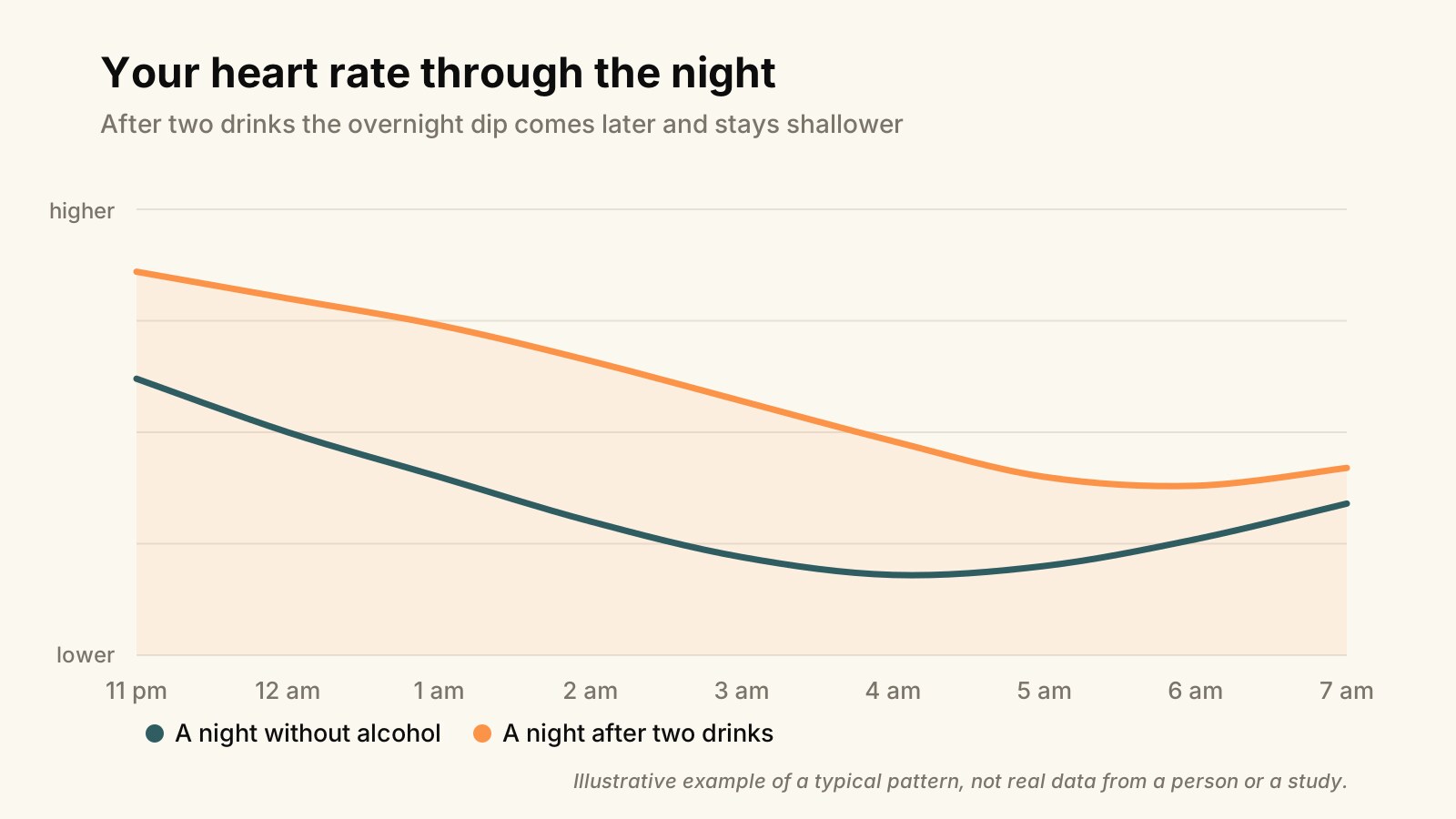
On a normal night your heart rate drops after you fall asleep and bottoms out somewhere in the second half of the night. After drinking, that dip is smaller and it comes later.
A 2025 study from Ludwig Maximilian University of Munich had 40 healthy adults wear smartwatches for nine days, including three days with a set amount of alcohol. On drinking days, their average nighttime heart rate went up by about 3 beats per minute. It went back to normal once they stopped (Strüven et al., Nutrients, 2025). Almost half of them also said they slept less restfully.
Three beats doesn’t sound like much. Over a whole night, it adds up to thousands of extra heartbeats, and it’s easy to spot on a trend graph.
Alcohol and HRV: the clearest signal
HRV, or heart rate variability, is the tiny change in timing between one heartbeat and the next. A higher HRV at night usually means your body is in recovery mode. New to it? Our guide to understanding heart rate variability covers the basics.
The biggest real-world study on this looked at more than 12,000 nights from 4,098 Finnish employees. Compared with alcohol-free nights, HRV in the first three hours of sleep fell with every extra drink. Their recovery score dropped by about 9 points after a low dose, 24 after a moderate one and 39 after a high one (Pietilä et al., JMIR Mental Health, 2018).
Two things in that study surprised a lot of people:
- One or two drinks was enough. Changes showed up at low doses, around 0.25 g of alcohol per kg of body weight. For a 70 kg adult, that’s a little more than one standard drink.
- Being fit didn’t protect anyone. Active people and couch potatoes saw a similar effect. Same for men and women.
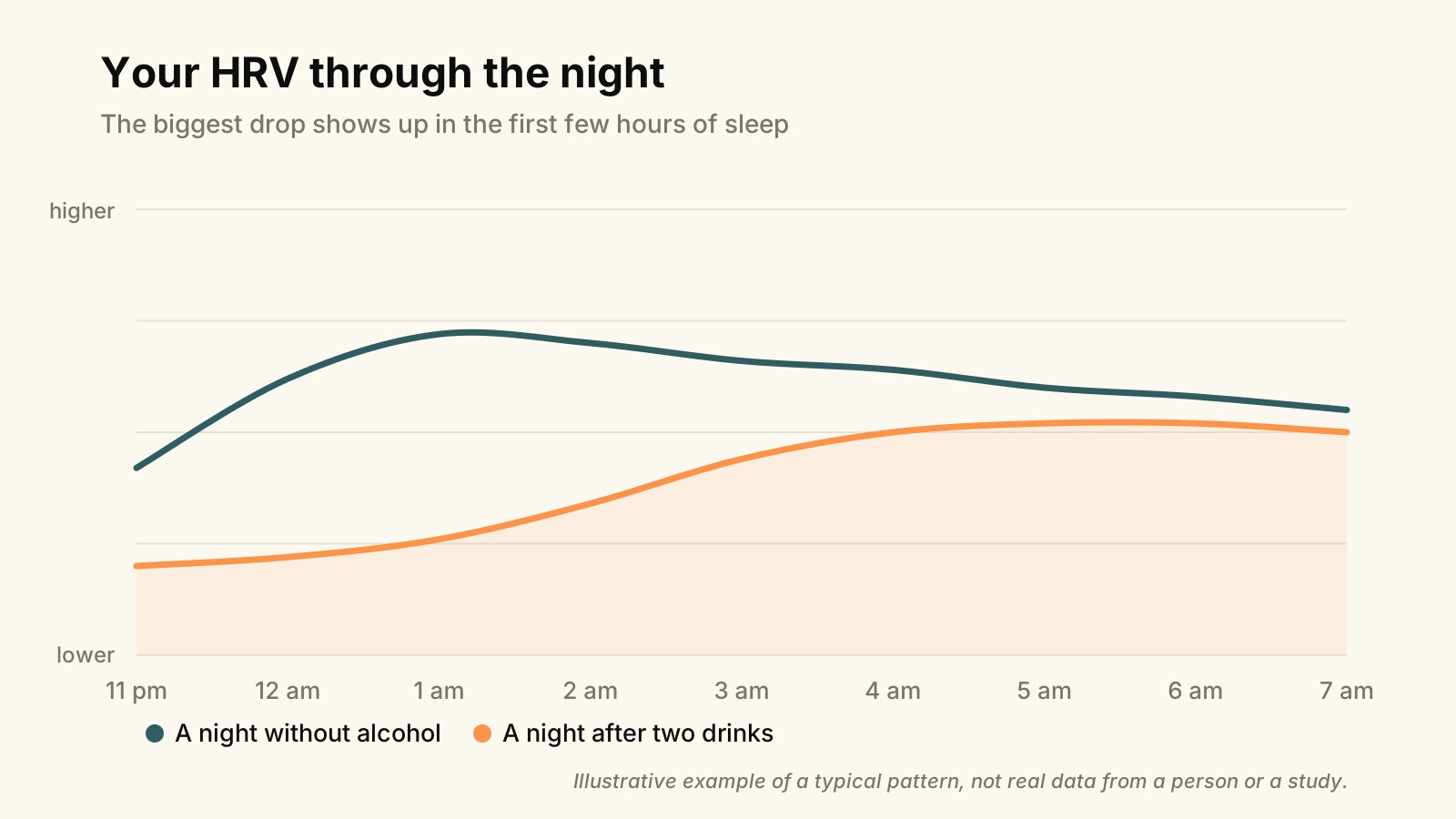
Try it: one drink or four?
Tap an option below to see how a typical night shifts as the drinks add up.
How many drinks tonight?
Pick one to see a typical night.
What happens to your sleep stages
Alcohol doesn’t just change your heart. It reshuffles the whole night. A big review of decades of sleep research found the same pattern again and again (Ebrahim et al., Alcoholism: Clinical and Experimental Research, 2013):
- You fall asleep faster.
- Early sleep can be deeper.
- REM sleep gets squeezed in the first half of the night.
- The second half gets lighter and more broken as your body clears the alcohol.
REM is the stage tied to memory, mood and working through emotions. For a refresher, here’s how the stages of your sleep cycle fit together, plus a few tips to increase your REM sleep.
It also explains the classic 3 or 4 a.m. wake-up. Sometimes it’s a bathroom trip, sometimes there’s no obvious reason. On a tracker it shows up as more awake time and restlessness in the early morning.
How long does alcohol affect HRV?
For most people it hits hardest that same night and fades over the next one or two. In the Munich study, heart rate was back to baseline as soon as the alcohol-free days started.
How fast you bounce back depends on how much you had, how late, how long you slept, how hydrated you were and what your normal looks like. The only way to know your own pattern is to look at your own data.
How to read your data the morning after
One night is noise. A pattern is information. A few habits make your numbers a lot more useful:
- Compare with yourself. Check your HRV and resting heart rate against your own usual range, not someone else’s.
- Log the drink. What, how much and when. A quick tag in the app is enough, and after a few weeks the patterns jump out.
- Look at the shape of the night. A heart rate that stays high until 5 a.m. tells you more than one average number.
- Check the next night too. Back to normal in 24 hours? Good to know. Takes two or three nights? Also good to know.
Give it a month and most people find their own line: an amount, or a time of the evening, after which their numbers clearly drop.
Simple ways to soften the hit
You don’t have to skip the wine at dinner to sleep well. Small changes usually show up in your numbers:
- Drink earlier. Try to finish your last drink at least three hours before bed, so your body can clear more of it before you sleep.
- Have one less. The effect grows with every drink, so one usually costs a lot less than three.
- Alternate with water. A glass of water between drinks helps your body recover overnight.
- Eat something. Food slows down how fast alcohol gets into your blood.
- Keep your bedtime steady. A late night on top of a few drinks is a double hit.
- Plan around the big days. Race, big meeting, long drive? An alcohol-free evening the night before tends to show in your numbers.
When to talk to a doctor
If you need a drink to fall asleep, feel your heart racing or pounding at night, or keep seeing heart readings that look off, talk to a healthcare professional. A wearable can show you trends. It can’t tell you why they’re happening. Circular is not a medical device and does not replace a doctor.
FAQ
Does alcohol lower HRV?
Yes, for most people. Large real-world data shows HRV during sleep drops after drinking, and the more you drink, the bigger the drop.
Why is my heart rate high after drinking?
Breaking down alcohol pushes your nervous system into its “go” mode and widens your blood vessels, so your heart beats faster to keep blood moving. Studies see nighttime heart rate rise by a few beats per minute on drinking days.
Does one glass of wine affect sleep?
It can. Researchers saw changes in heart rate and HRV even after one or two drinks. The effect is smaller than after a big night out, but it is there.
How long does alcohol affect HRV?
Usually one to two nights. It depends on how much you had, how late, how well you slept and how hydrated you were. Your own trend is the best guide.
Does alcohol reduce REM sleep?
Yes. It tends to cut REM sleep in the first half of the night and makes the second half lighter and more broken.
Is it better to drink earlier in the evening?
Generally, yes. The more time between your last drink and bedtime, the more alcohol your body can clear before you fall asleep.
See it in your own data
The Circular app tracks your sleep stages, nighttime heart rate, HRV, SpO2 and temperature, so you can see how your evenings show up in your nights. Tag a drink, check your numbers the next morning, and within a few weeks you’ll know your own line. Curious what’s next? Circular Ring 3 brings the same tracking to a lighter titanium ring.
Circular is not a medical device and does not replace a doctor.